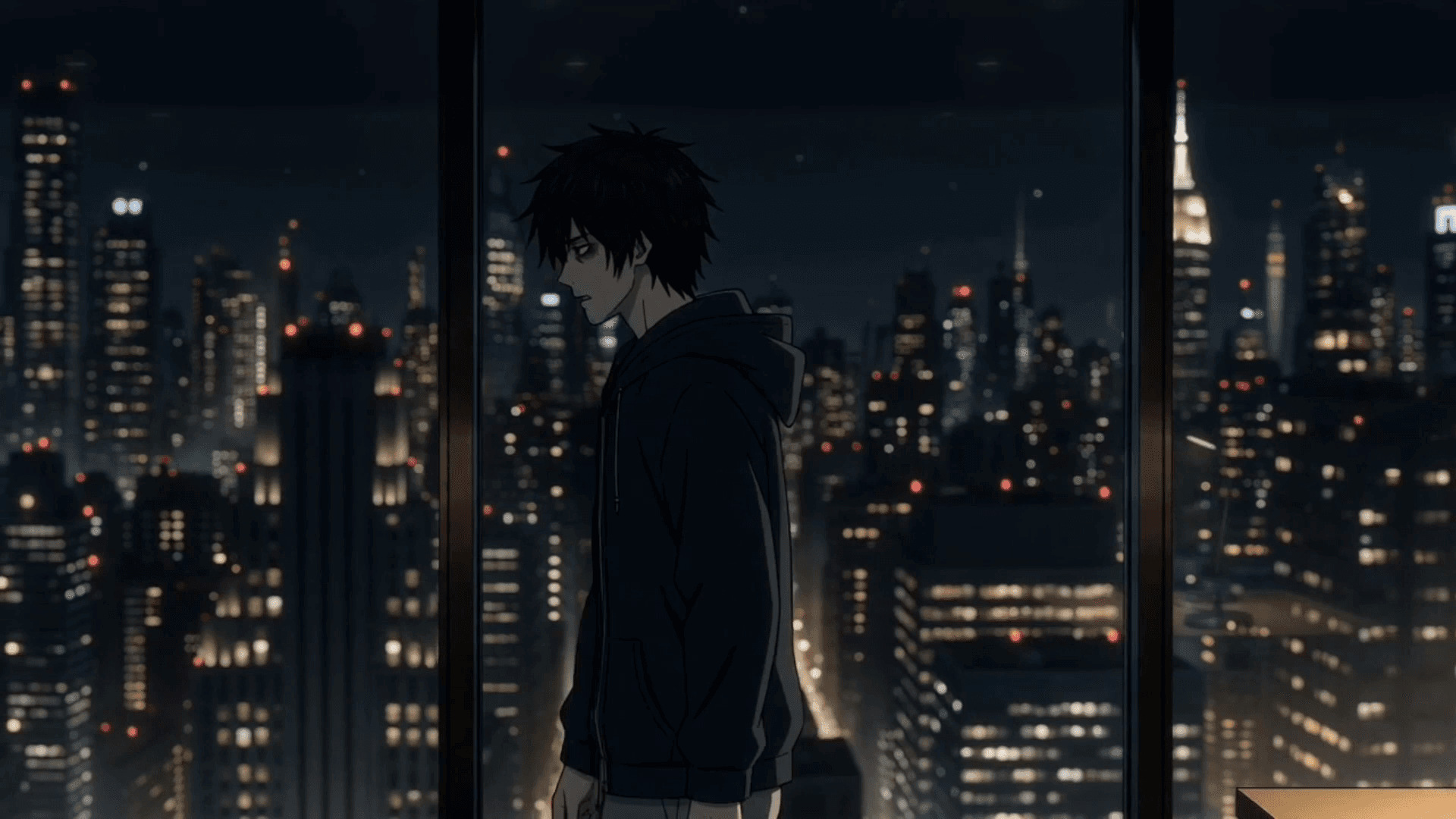
Finished sequence
In this sequence from one of my Lab Wars episodes, Sol and Luna are holding a gate open from across the room. Luna tells Sol to take Muse and escape. When he releases the wall, she absorbs the strain alone while he picks up Muse and runs.
The action needs to communicate several things clearly: how the gate stays open, why someone must remain behind, and how Sol gets from the wall to the exit. The emotional moment depends on those mechanics making sense.
I used a storyboard to work through that progression before generating the video.
Start with the action the audience needs to understand
I began by describing the full sequence to the agent: Luna tells Sol to leave, he protests, she insists, he releases the wall, and she struggles to hold the gate open while he escapes with Muse.
That gives the agent the events to work from. The next step is deciding how the audience will see them.
For this shot, the essential moments were:
- Sol and Luna holding the gate open together.
- Sol realizing what Luna is asking him to do.
- Luna insisting that he leave.
- The physical consequence when Sol lets go.
- Sol collecting Muse and running toward the gate.
A starting keyframe can usually establish the opening composition. But in this situation, I needed to plan several compositions and actions within the generated clip, so a storyboard gave me more room to direct the sequence.
Give the agent direction on angles and panels
I asked the agent to help design the storyboard from my action description.
The more precise I am about the coverage and the number of panels, the closer the result tends to be to what I imagine.
For this sequence, the board uses six panels:
- A wide view establishes Sol, Luna, Muse, and the open gate.
- A close-up of Sol shows his reaction to Luna’s instruction.
- A close-up of Luna emphasizes her urgency and effort.
- A wider action view shows Sol releasing the wall as Luna takes the strain.
- A closer view shows Sol gathering Muse.
- A final wide view shows the distance between Luna, still holding the wall, and Sol escaping toward the gate.
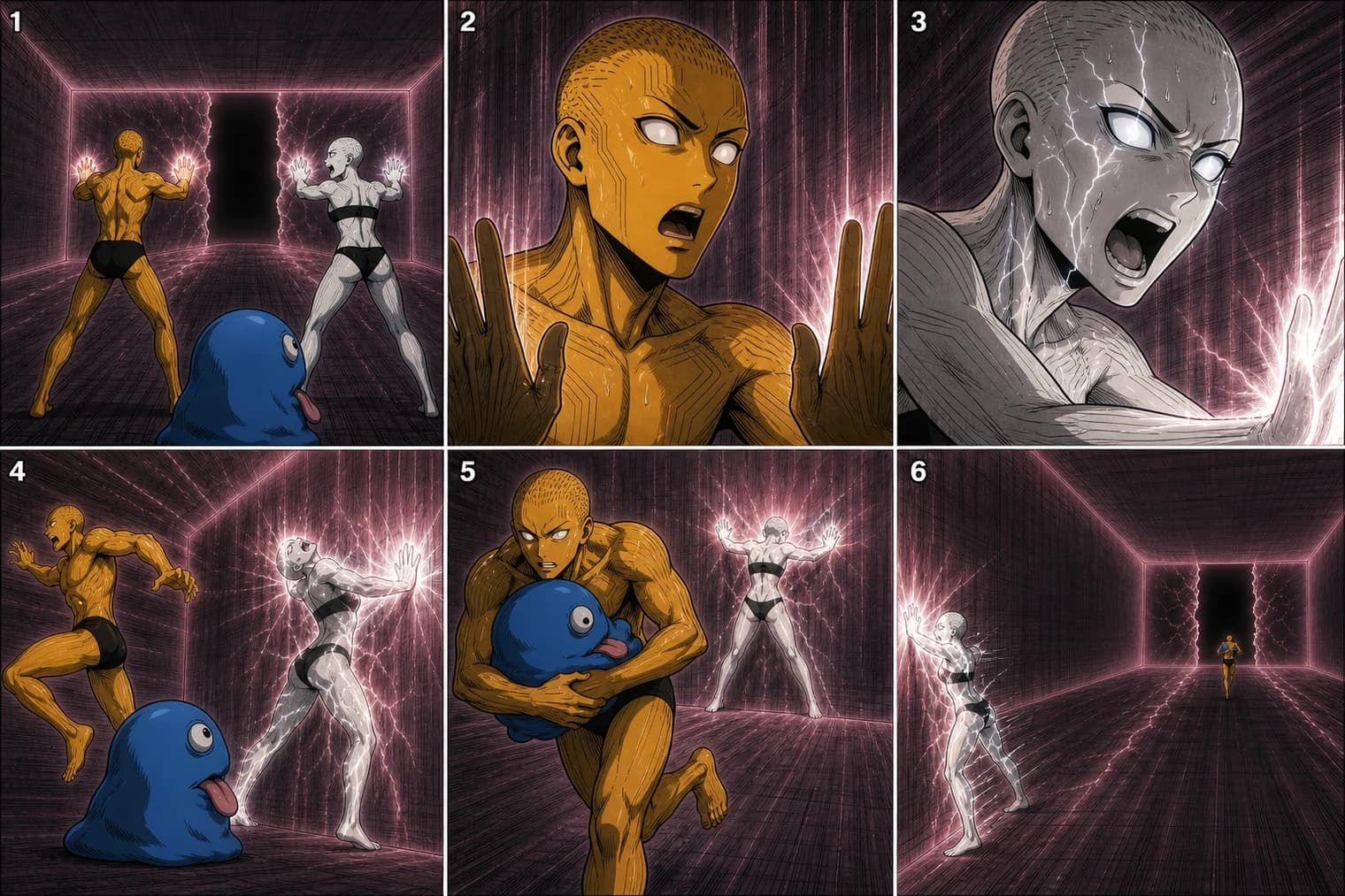
The close-ups give the decision emotional weight. The wider compositions explain the physical action and the space the characters move through.
You can describe those choices directly to the agent. If you’re uncertain about the coverage, ask it to propose a panel sequence, then revise the views that don’t communicate what you need.
Keep the storyboard and shot breakdown aligned
The storyboard is one part of the shot’s direction. Fringe’s timed breakdown also carries the action and dialogue, and the two need to agree.
In this example, the six-panel board fits into four timed sections:
0–4 seconds
Establish the shared effort. Luna tells Sol to take Muse and run.
4–7 seconds
Sol protests; Luna tells him to go. The board shows their reactions in close-up.
7–10 seconds
Sol releases the wall, and Luna takes the strain alone.
10–12 seconds
Sol picks up Muse and runs toward the gate while Luna remains behind.
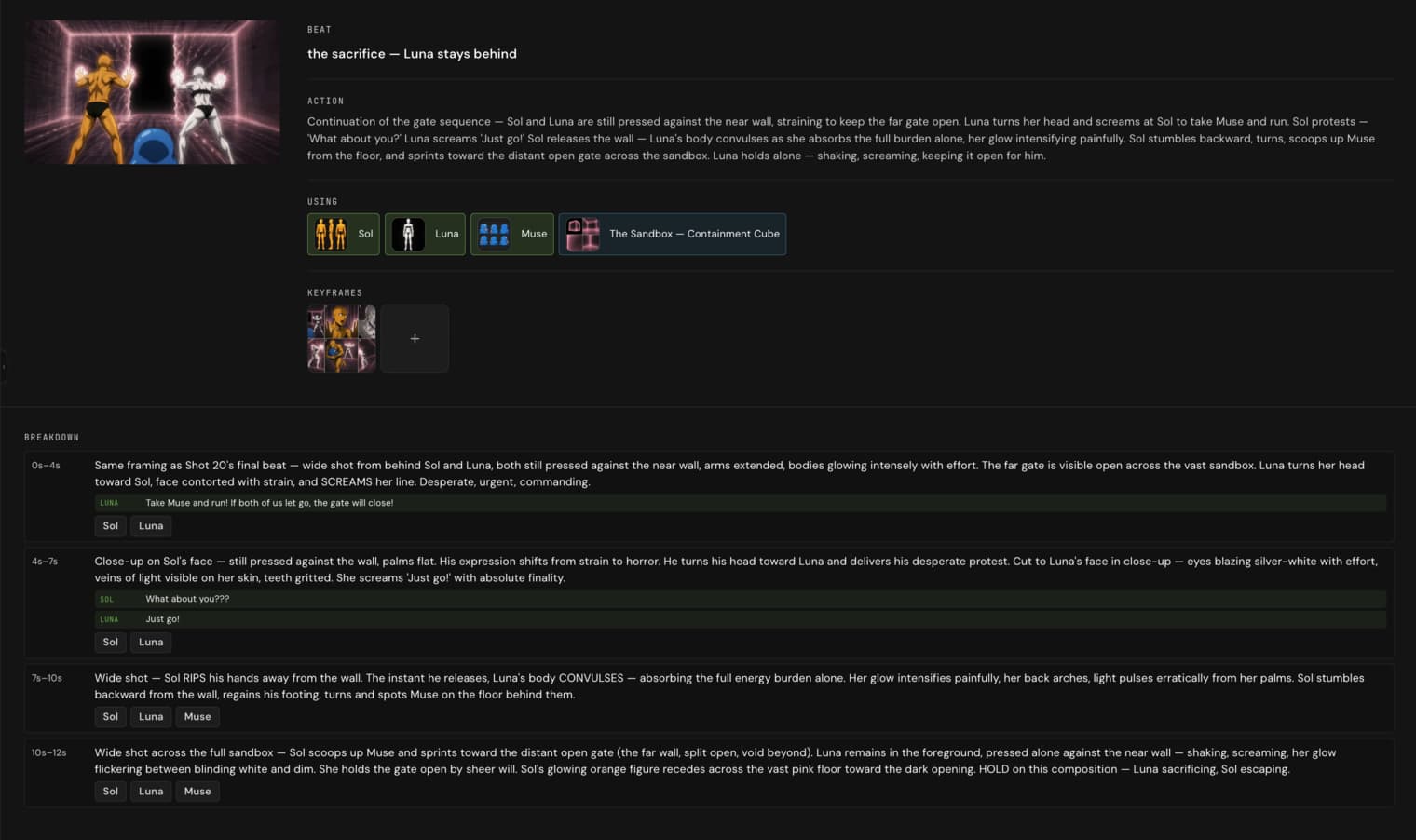
The number of panels doesn’t have to match the number of timed sections. Two close-ups can belong to the same dialogue section. What matters is that both describe the same order of events. However, if they do correlate directly, visualizing the shot with the breakdown can feel much simpler.
Ask the agent to check them together: do the camera angles match, is each action accounted for, and does the dialogue occur at the intended moment? Resolve contradictions before generating.
Carry the staging across consecutive shots
An action sequence often extends across several shot blocks. Each new board needs to continue from the scene already established.
For the escape sequence, I asked:
For shot 21, take the storyboard from shot 20 and use it as a reference, since these scenes are back to back.
Shot 22 then referenced Shot 21.
That gave the agent a visual basis for carrying forward the characters’ positions, the wall they were pressing against, and the gate across the room.
When reviewing connected boards, check the geography as well as the character designs. The audience needs to understand where the exit is and how the characters can reach it.
If the video misses, check how it follows the board
A storyboard gives the generation a plan, but the result still needs reviewing.
Earlier in this escape sequence, Shot 20 generated with the gate on the wrong wall. I asked the agent to inspect the storyboard and rewrite the breakdown and generation prompt to follow it.
That was a specific staging problem. The correction needed to make the relationship between the characters, the wall, and the gate explicit.
When a take misses, compare it with the relevant panels. Identify the action, angle, or spatial relationship that changed, then have the agent bring the generation instructions back into agreement with the board.
Shape the action in the edit
I also do a substantial amount of cutting and editing when assembling action sequences into the episode. The storyboard gives me a planned progression, but I find the action benefits from another pass once I can watch the generated footage.
At that stage, I’m judging the rhythm: how long to hold a reaction, when to move into the next action, and whether a pause adds tension or slows the sequence down. The timing that looked right in the breakdown may need adjusting in the finished scene.
I treat the generated clips as material for the edit. Not every second needs to stay. The board helps establish clear action; editing lets me refine how that action plays for the audience. The finished clip at the beginning of this guide is what you see after editing.
Build a sequence you can read before it moves
Storyboarding helped me work through both the action and its presentation. I could see where a wide shot needed to establish the room, where a close-up should hold a reaction, and how one movement led into the next.
Start by describing the complete action. Then work with Fringe’s agent to choose the panels, refine the camera angles, and align the board with the timed breakdown.
For this scene, the goal was for the audience to understand Luna’s sacrifice through what they could see: Sol leaves, the burden falls on her, and she holds on long enough for him to escape.